
On this page
- Franklin's historic districts
- Review and the Certificate of Appropriateness
- Gutter styles on older houses
- Repairing rather than replacing
- Practical concerns on older houses
- Historic gutter terms
- Neighborhood pages
- Questions to ask before work on an older house
- Built-in and box gutters
- Matching the house
- Working with a contractor on an older house
- Trees and older streets
Franklin's historic districts
Franklin protects its historic core through local historic districts and the historic preservation overlay. According to the city's design guidelines, there are seven local districts:
| Local historic district | Notes |
|---|---|
| Downtown | The original town plan and Main Street |
| Hincheyville | West of downtown along West Main |
| Lewisburg Avenue | South of downtown |
| Adams Street | Near downtown |
| Boyd Mill Avenue | West side |
| Everbright Avenue | Five parcels |
| Franklin Road | About two miles of the corridor north of downtown |
The guidelines also list five National Register districts: the Franklin Historic District, Hincheyville, Lewisburg Avenue, Adams Street and Natchez Street. The preservation plan notes that the original 16-block town plat was listed on the National Register in 1972, Hincheyville in 1982 with 71 properties, and Lewisburg Avenue in 1988 with 40.
Review and the Certificate of Appropriateness
In the local districts, exterior work covered by the guidelines needs a Certificate of Appropriateness from the Historic Zoning Commission or staff before it starts. Ask preservation staff before changing the material, profile or position of gutters on a reviewed building. A good contractor who works downtown will be used to this.
Gutter styles on older houses
| Style | Where you see it |
|---|---|
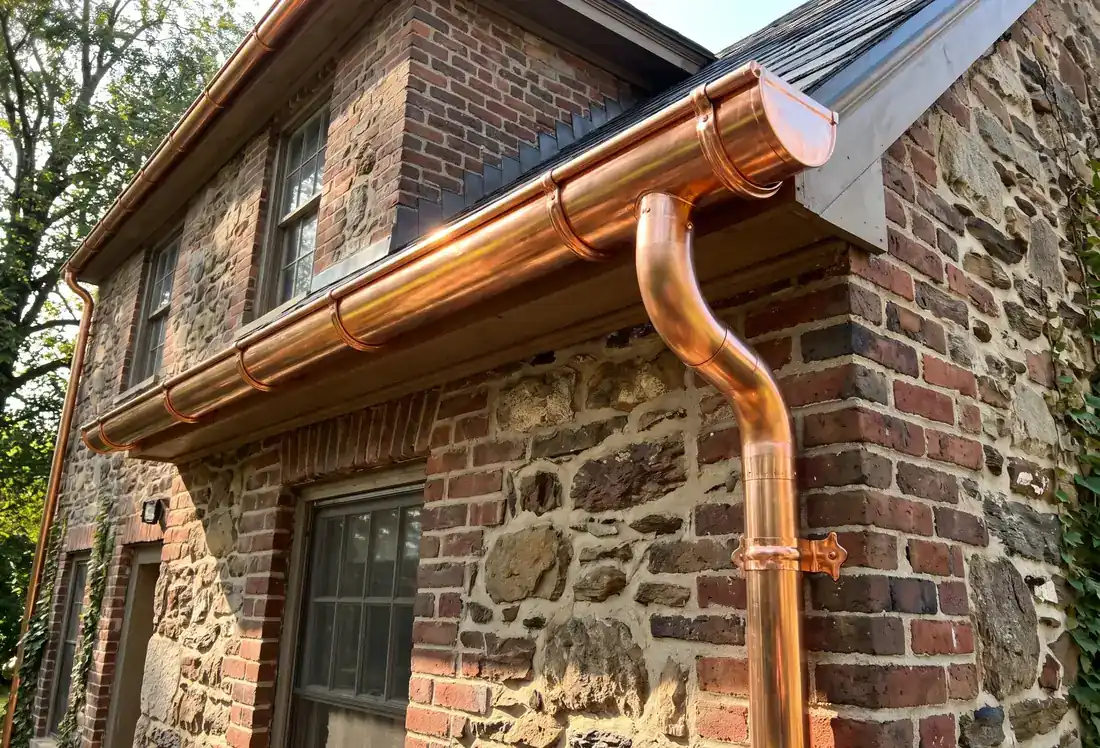
| Half-round with round downspouts | Victorian, Greek Revival, Craftsman and early 20th-century houses |
| Built-in or box gutters | Cornices of older brick buildings |
| Copper | Higher-end and masonry homes |
| K-style | Later houses and some replacements |
The city's guidelines glossary describes half-round gutters as typical of houses built before about 1960.
Repairing rather than replacing
- Built-in gutters can often be relined rather than removed.
- Cornices may need custom-milled trim to match.
- Copper can be patched and soldered.
- Brackets can be reset into sound wood.
Practical concerns on older houses
| Concern | Approach |
|---|---|
| Old, patched fascia | Probe and repair before hanging |
| Brick and stone walls | Round downspouts, straps into mortar joints |
| Deep porches | Small gutters with careful discharge |
| Tall eaves | Safe access is part of the price |
| Basements and crawl spaces | Discharge well away from old foundations |
Historic gutter terms
| Term | Meaning |
|---|---|
| Half-round gutter | A tube cut in half, hung on brackets; typical of older houses |
| Box gutter | A deep rectangular gutter, often built into the eave on older or commercial buildings |
| Copper | Sheet sold by weight per square foot, usually 16 or 20 oz; weathers brown, then green |
| Collector head | A box at the head of a downspout that gathers water from a scupper or gutter |
| Scupper | An opening in a parapet that lets a flat roof drain |
| Fascia | The trim board across the rafter ends; hangers screw into it |
Neighborhood pages
See also half-round gutters and copper gutters.
Questions to ask before work on an older house
- Is the house in a local historic district or only on the National Register?
- Does the work change the gutter profile, material or position?
- Is the fascia or cornice original, and can it be repaired?
- Are there built-in gutters under later add-ons?
- How will water be kept away from old foundations?
Built-in and box gutters
Many older brick buildings in Franklin have gutters built into the cornice and lined with metal. When the lining fails, water gets into the cornice and wall. Relining with new metal, often copper or terne-coated steel, keeps the original look. Covering over a built-in gutter and adding a hanging gutter is sometimes done, but in a local district it may need review.
Matching the house
| Feature | Good match |
|---|---|
| Half-round gutters | Round downspouts |
| Copper | Copper brackets, straps and collector heads |
| Painted wood cornice | Painted fascia rather than aluminum wrap |
| Brick walls | Downspouts strapped into mortar joints, not brick faces |
Working with a contractor on an older house
Choose a contractor who has worked on houses of the same age. Ask to see similar jobs, whether they can supply half-round and copper, how they handle cornice repair, and whether they have taken projects through review in Franklin's historic districts before. A clear written scope helps if a Certificate of Appropriateness is needed.
Trees and older streets
Franklin's historic neighborhoods are among its most heavily shaded. Big oaks and maples drop leaves late into the year and seeds in spring, so older houses often need three or four cleanings, or guards suited to half-round where available. Limbs over old roofs are worth having checked by a tree professional, since a single fall can crush gutters and cornice together.